
- Press Releases
Consumers for Quality Care Urges Congress to Lower Costs, Remove Barriers to Care and Hold Big Insurers Accountable
In response to Senate Finance Committee RFI, CQC calls for reforms to protect patients from excessive cost-sharing, prior authorization and insurer consolidation
Washington, D.C. — Today, Consumers for Quality Care (CQC) submitted formal comments to the Senate Committee on Finance in response to its Request for Information (RFI) on Health Coverage That Works for Everyone, led by Ranking Member Ron Wyden. In its comments, CQC urged Congress to advance patient-centered reforms that lower out-of-pocket costs, remove unnecessary barriers to care and hold large insurance companies accountable for practices that put profits ahead of patients.
The Senate Finance Committee’s RFI seeks feedback on reforms related to affordability, access to care and insurer practices, including cost-sharing, prior authorization and vertical integration. Senate Finance Committee CQC’s response emphasizes that meaningful health coverage reform must address not only whether patients have insurance, but whether they can actually afford and access the care their coverage is supposed to provide. CQC called on Congress to scrutinize insurer practices that shift costs onto patients, delay or deny medically necessary care and allow vertically integrated companies to profit across multiple parts of the health care system.
“Having health insurance should mean that patients can get the care they need without facing overwhelming costs or unnecessary roadblocks,” said Jim Manley, CQC Board Member and former senior advisor to Senators Edward Kennedy and Harry Reid. “Too often, patients are paying higher deductibles and coinsurance while navigating prior authorization requirements and other barriers imposed by insurers. Congress has an opportunity to put patients back at the center of the health care system by lowering costs, simplifying access to care and holding insurers accountable.”
In its comments, CQC urged Congress to prioritize reforms that would:
- Protect patients from excessive out-of-pocket costs, including by limiting or eliminating coinsurance and passing the bipartisan HELP Copays Act to address copay accumulators and maximizers that can prevent financial assistance from counting toward patients’ deductibles and out-of-pocket costs;
- Reform prior authorization and other barriers to medically necessary care, including prohibiting insurers from using artificial intelligence to deny care and advancing reforms such as the bipartisan Safe Step Act to establish stronger protections for patients;
- Address insurer consolidation and vertical integration that allow insurance companies to own providers, pharmacies and pharmacy benefit managers while moving health care dollars among affiliated businesses;
- Strengthen accountability for Medical Loss Ratio practices and advance the bipartisan Break Up Big Medicine Act to address insurer ownership across the health care system and promote a more competitive, consumer-friendly market.
“Patients should not have to fight their insurance company just to use the coverage they pay for,” Manley added. “Whether it is unpredictable cost-sharing, months of prior authorization delays or corporate structures that reward insurers for steering patients toward businesses they own, the system should work for consumers, not against them. We appreciate Ranking Member Wyden’s leadership in examining these issues and encourage Congress to pursue reforms that improve affordability, strengthen accountability and ensure patients can access high-quality care.”
CQC’s full comments are available below.
October 2, 2026
The Honorable Ron Wyden
Ranking Member
Senate Committee on Finance
Re: Request for Information on Health Coverage That Works for Everyone
Dear Ranking Member Wyden:
Thank you and your colleagues for this opportunity to share ideas about how health coverage can work better for everyone. At Consumers for Quality Care (CQC), we believe that America’s healthcare system should put patients first. Our coalition of health care consumer advocates and former policymakers aims to give patients a voice in the health care debate as they demand better care. To that end, we advocate for consumer-friendly reforms that lower costs, broaden access to care, and increase both transparency and accountability throughout the health care system.
These reforms are sorely needed in the health insurance industry, where the biggest players have perfected the art of shifting costs to patients and erecting barriers to care. These tactics have allowed insurers to reap billions in profit at the expense of working-class Americans. Worse, the consequences of their profiteering fall hardest on vulnerable populations, including the poor, senior citizens, people with disabilities, and people living with chronic illnesses.
Thankfully, you and your colleagues are bringing congressional scrutiny to this problem. We encourage you to pursue every available avenue to hold insurers accountable and to re-shape their incentives so that they prioritize high-quality, affordable healthcare.
- Reversing Cuts and Imagining a Better Path
Insurance companies are systematically shifting costs onto patients, including by sharply increasing deductibles, imposing coinsurance requirements, and using so-called copay accumulators and copay maximizers. These tactics raise out-of-pocket costs for patients, creating barriers to care that not only hurt patients’ finances but also hurt their health and well-being.
In your Request for Information (RFI), it was noted that researchers and advocates have raised doubts about whether coinsurance “has any role in a health coverage system that is truly protective of patients.” We, too, are doubtful that coinsurance serves a legitimate utilization management purpose, and we believe that if Congress must allow the practice to continue, then it should be severely limited in its application. But as to whether it should be allowed at all, the burden of proof ought to rest with the big insurance companies using this practice. As the RFI suggested, insurers should be required to provide data and analysis proving that coinsurance does in fact encourage more efficient use of health care services, rather than merely discourage patients from seeking needed medical care due to high costs.
Although copay accumulators and maximizers are not mentioned in your Request for Information, we believe that these tactics hurt patients and merit congressional scrutiny. First, a brief explanation of how copay accumulators work. Most insurance plans have a deductible, which requires patients to pay a certain amount out-of-pocket toward their care before the insurance company begins to cover the cost and all non-grandfathered Affordable Care Act-compliant health plans are subject to annual maximum out-of-pocket limits for essential health benefits. With copay accumulators, insurers arbitrarily decide that coupons or even charitable contributions that a patient may receive toward their care will not count toward their deductible or maximum out-of-pocket limits. This forces patients to pay out-of-pocket, and it allows insurers to capture a double payment from the coupons and other assistance that are intended to lower patients’ costs and the patient’s actual deductible. These tactics may also result in a “copay surprise” when the value of coupons or charitable assistance is depleted. Copay maximizers evenly apply the value of a coupon or charitable assistance over the course of a plan year but also excludes those amounts from deductibles and out-of-pocket maximums, again allowing insurers to double-dip at patients’ expense.
These two tactics – copay accumulators and copay maximizers – leave patients with both higher out-of-pocket costs and reduced access to treatment. This causes patients to miss treatment doses or to abandon their treatment altogether, causing their condition to worsen, leading to more pain and suffering and often increasing the long-term cost of treating their illness.
Notably, the insurance companies that use these tactics don’t disagree. According to recent survey data, a near super-majority of payers (60%) strongly agree that copay accumulators have the potential to shift costs from plan sponsors to patients. Most (54%) agree that copay accumulators can hurt patients’ ability to afford medications that they regularly need, and roughly 25% believe that they could discourage patients from using specialty therapies, including therapies that effectively treat rare or chronic conditions like cancer, rheumatoid arthritis, and HIV.
To protect patients, Congress should pass legislation that either ban or severely limit these cost-shifting tactics such as the bipartisan HELP Copays Act, which would effectively ban copay accumulators and maximizers, at the very least for federally regulated, large-group, and self-insured employer plans. This would lower barriers to accessing care and increase adherence to medically necessary treatments, thereby improving health outcomes and reducing downstream costs.
More than half of all states have already enacted similar legislation, but these laws do not affect plans regulated by the federal government. In these states, the HELP Copays Act would close a loophole that leaves many patients vulnerable, and in other states, it would encourage state lawmakers to advance bills of their own to ban copay accumulators and maximizers from state-regulated plans.
- Making Healthcare Simpler for Families
Health insurers often use prior authorization not, as they say, to prevent fraud or encourage evidence-based care, but to pad their profits by delaying and even denying access to care.
Although many denials are eventually approved on appeal, most patients don’t appeal their denials. Many people don’t have the time to spend hours on the phone, often over many months or years, pressing their case with their insurance companies. Others don’t even know that they have a right to appeal, and some who know feel that any appeal is unlikely to succeed. Insurance companies count on this. They build their business models on the assumption that too many people will be too busy, too discouraged, or too uninformed to challenge their denials. That has to change.
Prior authorization hurts both consumers and health care providers, albeit in different ways. For consumers, prior authorization delays access to care, forcing them to wait weeks, months, or even longer for necessary treatments, medications, or surgeries. While they wait for an approval that may never come, their medical condition may worsen, potentially hurting their long-term health outcomes. If a patient wishes to avoid these delays, their only option is to pay out of pocket, which many cannot afford to do. This is why 82% of doctors report that prior authorization sometimes causes patients to abandon medically necessary treatment, with more than one in four doctors saying that it led to a “serious adverse event” for a patient in their care.
For physicians and other health care providers, prior authorization burdens them with tedious administrative work that raises the cost of care and distracts them from the hard work of providing that care. Data show that the average physician completes roughly 40 prior-authorization requests each week, which takes almost two days of physician and staff time that would otherwise have been spent caring for patients. In fact, 40% of physicians have one staff member – some more than one – whose sole job is responding to the high volume of prior-authorization requests from insurers, according to the American Medical Association. Another study found that prior-authorization paperwork consumes the equivalent of 99,290 full-time physician workloads, which is more than the nation’s current shortage of physicians. This is a sizable layer of cost and bureaucracy in our health care system, and it exists solely because insurers can profit by micro-managing the patient–physician relationship.
Worse, some insurers are now using Artificial Intelligence, or A.I., to manage the prior-authorization process and issue coverage denials. It’s bad enough that insurance companies are second-guessing our doctors and other health care providers. It’s beyond intolerable, however, that any person might have their access to doctor-prescribed care denied without qualified oversight.
To make care simpler for families, Congress should ban insurance companies from using A.I. to deny care. It should also ban prior authorization entirely. But if such a sweeping ban isn’t possible, Congress should at least consider restricting or streamlining the practice. There is, for example, H.R. 5509, the bipartisan Safe Step Act. This bill, if passed, would require insurers to allow exceptions to prior authorization and would set strict time limits for processing any requests for exceptions. This represents a significant improvement over the status quo.
- Taking on Corporate Greed
Current law rewards insurers for buying healthcare providers, pharmacies, and pharmacy benefit managers (PBMs), which give them many ways to increase profits by raising costs for patients. One major way to do this is by gaming Medical Loss Ratio (MLR) requirements. These requirements require insurers to spend at least 80% to 85% of premium dollars on medical care and quality improvement, not on profits or administrative costs. But by owning physician groups, pharmacies, and PBMs, insurers can essentially pay themselves while also setting the prices that they pay.
Here’s an example of how this works with just one large insurer, UnitedHealth Group. A recent study found that UnitedHealth paid 17% more for common health services provided by Optum, which it owns, than it paid for common health services provided by other physician groups in the same region. Worse, in markets where UnitedHealth has significant market share, the difference between what it pays its own physicians and what it pays other physicians increases to 61%. That difference represents money that should belong to patients but that instead goes to boost UnitedHealth Group’s profits.
Another example: In 2016, UnitedHealth Group recorded $47.3 billion in intercompany eliminations, or money that one part of the company paid to another part of the company, mostly to its own physician groups, pharmacies, and so on, according to Healthcare Uncovered. But those intercompany payments have risen significantly every year, and by 2025, they totaled more than $167 billion. In fact, almost half of all the revenue that UnitedHealth Group earned in 2025 was in this kind of self-dealing, whereby funds (including money from insurance premiums) was moved internally to UnitedHealth’s own physician groups, pharmacies, and other business segments.
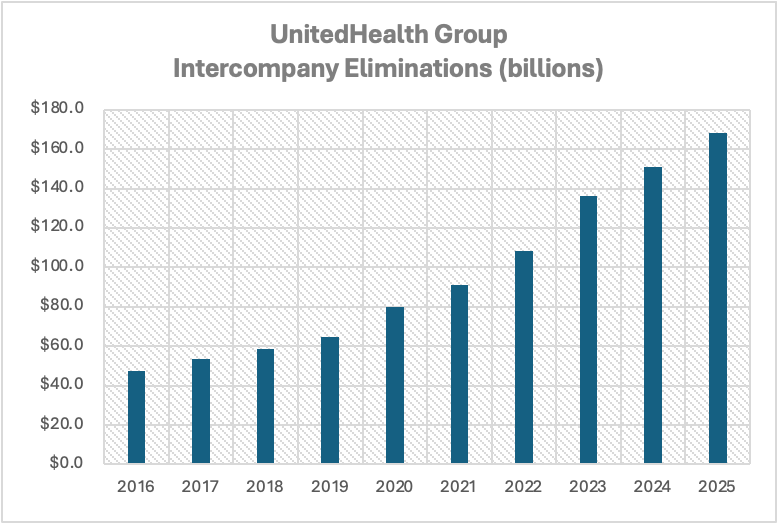
Vertical integration represents a big loophole in federal MLR requirements. Rather than paying money out for our care, insurance companies are simply moving funds (including our premium dollars) from their front pocket to their back pocket, thinking that no one will notice that the money is staying with them. The harm to consumers, however, is not only noticeable but growing, as shown above. That harm includes higher costs for patients, as insurers inflate the prices that they pay to themselves. It includes fewer consumer choices, as insurers steer patients toward the pharmacies, physician groups, and other healthcare companies that they own. Likewise, it also includes more barriers to care, as insurers steer patients away from providers that they don’t control.
Congress can – and should – close this loophole by banning insurers from vertically integrating, and the best, cleanest way to accomplish this is by passing the bipartisan Break Up Big Medicine Act. This bill, if enacted, would ban insurers from owning providers, pharmacies, and other health care providers. It would also ban those healthcare providers from owning insurance companies. The result would not only be a more competitive and consumer-friendly healthcare market but also put an end to MLR gamesmanship.
Conclusion
CQC is grateful for your leadership in examining these important issues and looks forward to continuing to work with Congress to develop patient-centered policies that improve affordability, strengthen accountability, and ensure that all Americans can access high-quality healthcare.